
How is Barcelona’s public transport network organised?
Who are the main protagonists and what do they do?
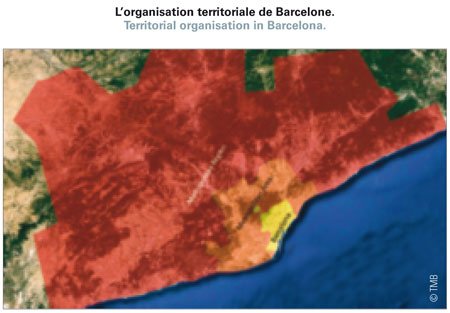
Navigating the intricacies of Barcelona’s public transport system is no easy task for the uninitiated. A complex organisation, the city’s network comprises a large number of private and public bodies skilled in various realms and serving different areas. To begin with, it is important to understand that the public transit system is organised on territorial lines, from the Municipality of Barcelona to its surrounding Metropolitan Area (AMB) and the Metropolitan Region beyond (see picture). In each territory, a variety of public and private stakeholders hold sway.
In terms of transport operators, the TMB (Transports Metropolitans de Barcelona) is the principal body in the Municipality. This public company, affiliated to AMB, manages eight metro lines, 102 regular bus routes and several tourist transport services, such as the Montjuïc Cable Car. Another company, FGC
In addition, there are a number of private stakeholders. For example, the city’s two non-tourist tramway lines are operated by Tramvia Metropolità
To oversee this complicated system – save for a few exceptions, including tourist services and some parts of the Renfe network – the Autoritat del Transport Metropolità (ATM) was created in 1997. A public body, ATM brings together each of the public authorities in the Metropolitan Region that have transport responsibilities: the Government of Catalonia (51 %), the City of Barcelona (25 %) and AMB (24 %)
Ferrocarrils de la Generalitat de Catalunya.
A consortium comprising companies like Vivendi, Alstom and Société générale.
The Spanish government is represented on the ATM management board and in the executive committee as an observer.